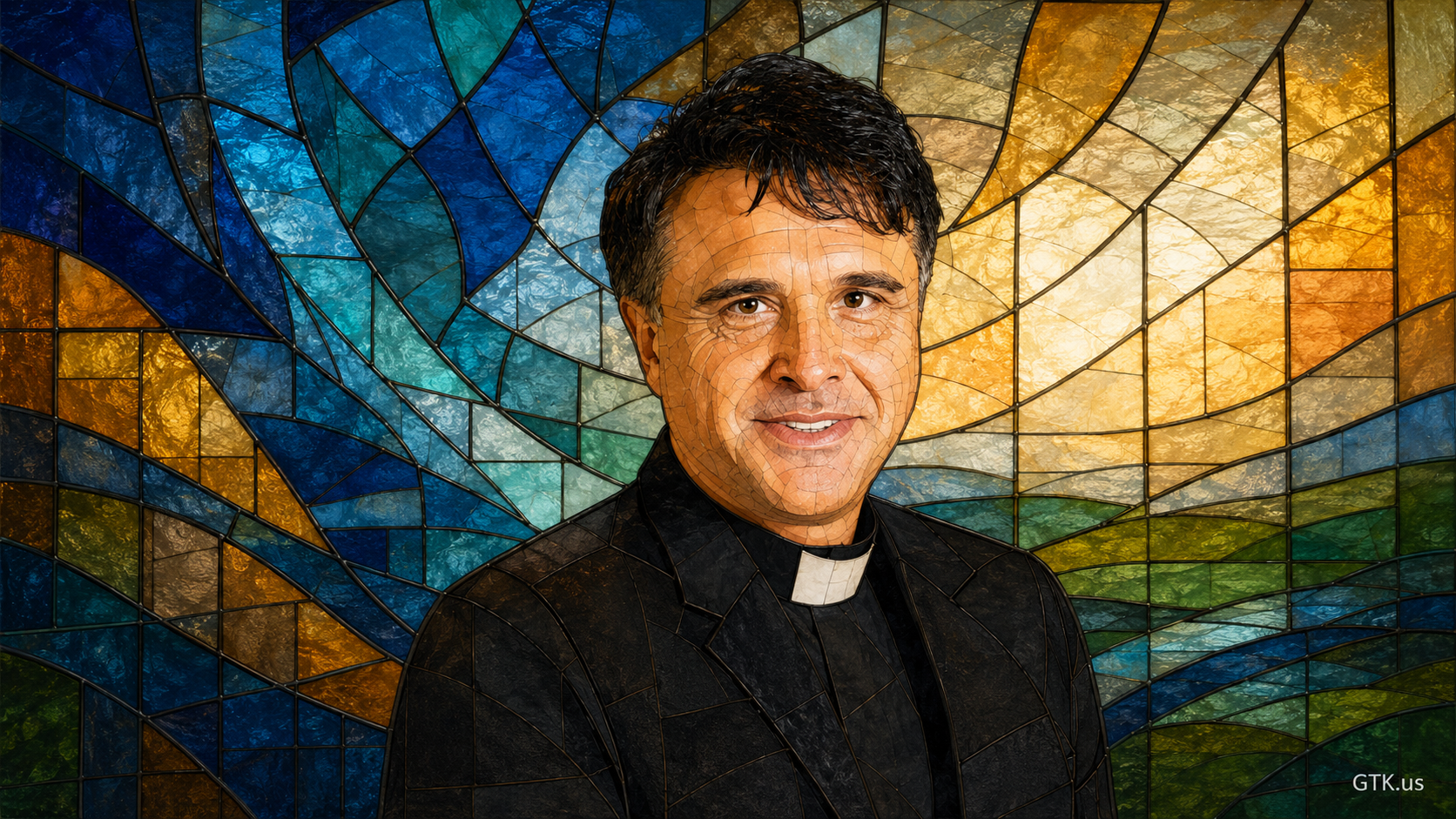
Best Known As Father Waldemar Maciag, Pastor of St. Lawrence Catholic Parish in Bushnell, Florida
Who is Waldemar Maciag?
Fr. Waldemar Maciag is a Polish-born priest, visual artist, musician, and former Arctic Circle missionary whose life has been shaped by faith, creativity, and a willingness to go wherever he was needed.
Father Waldemar Maciag, Pastor of St. Lawrence Catholic Parish in Bushnell, Florida
Fr. Waldemar Maciag was born and raised in Częstochowa, Poland, the spiritual capital of Poland and home to the Shrine of the Black Madonna at Jasna Gora. He is an artist, musician, songwriter, and missionary priest whose life has been shaped by a faith formed under communism, a vocation he never expected, and a creative spirit he never abandoned. Before the priesthood ever crossed his mind, he was a university art student with long hair and holes in his jeans, following his dream of becoming an artist. A retreat at a Carmelite convent changed everything.
Ordained in 1997, his journey took him from Poland to Sweden for six years of mission work, including one year in the Arctic Circle, before arriving in Florida in 2005. He has served the Diocese of Orlando for over two decades and was formally incardinated into the diocese in January 2025. Those who know him describe a priest who paints Stations of the Cross, writes lyrics for rock bands, designs windows inspired by the rural churches of his Polish childhood, and brings an artist's eye and a missionary's heart to everything he does.
WHO: Waldemar Maciag | WHOist: John Turbanada | 19th July 2026 | Source: Research | Sponsor: GTK ME | Known & Remembered | Verified by: Charles J de Guara
The information presented reflects what was known and inferred at the time of this writing.
Father Waldemar Maciag | Native of Częstochowa, Poland
Fr. Waldemar Maciag grew up in Częstochowa, the spiritual capital of Poland, a city defined less by its geography than by what stands at its center. The Jasna Gora Monastery houses the Shrine of the Black Madonna, one of the most revered pilgrimage sites in the Catholic world, Sunday visits to that shrine were simply part of how the week was organized for many people living there. He also served as an altar server nearly every day, attended catechism classes at his parish, and grew up surrounded by a faith that was practiced rather than merely professed.
Growing up under communism added a particular texture to that formation. Priests in Poland at the time were kept under a watchful eye by the state, making friendships with parishioners difficult and, at times, dangerous. The distance was enforced from the outside, not chosen from within. Fr. Maciag has spoken about his parish priest with genuine admiration, noting that no spoken direction ever passed between them, and yet the priest spoke volumes. "By his example, without any words, he spoke a lot to me," he recalled. "In Poland, the priests had to be distant, but they were loving, and their spiritual life was incredible. They were brave to fight communism."
That same household also nurtured his earliest creative instincts. His family raised him with a love of God, people, music, and painting, all of which would eventually shape the kind of priest he became. His mother, Teresa, who learned to sew under communist rule as a means of survival, later made the cassock he wore for his incardination into the Diocese of Orlando in 2025, stitching it from fabric he had brought back from the Holy Land on his 25th ordination anniversary. It was a quiet detail that contained a lifetime of a mother's hands, a son's vocation, and a country that shaped them both.
WHO: Waldemar Maciag | WHOist: John Turbanada | 19th July 2026 | Source: Research | Sponsor: GTK ME | Known & Remembered | Verified by: Charles J de Guara
The information presented reflects what was known and inferred at the time of this writing.
Father Waldemar Maciag | Free-Spirited Artist
Fr. Waldemar Maciag did not grow up wanting to be a priest. By his own description, he was a free spirit following his dreams to be an artist and musician, enrolled at a university in Poland, and living the kind of life that looked nothing like the priesthood. He had long hair and holes in his jeans. He has described himself, with a laugh, as looking like a rock star. The idea of a religious vocation had never crossed his mind.
What changed was a retreat at a Carmelite convent during his university years. A persistent feeling of discontent had been growing quietly beneath the surface of his life, and it was during that retreat that something broke through. He has described the moment with striking directness: "I recall that moment, how I was hit by God saying, 'I need you.' That's when I decided I would quit university. I answered, 'Whatever happens, I'm yours now.'" He left the retreat and left the university. He has reflected on that moment many times since, still finding it remarkable. "It was so unusual for me. I never saw that kind of holiness in me. I looked like a rock star. I had long hair and holes in my jeans. How does this happen?"
What is perhaps most telling is what he did not abandon. He did not leave art or music behind; he brought them with him. He was admitted to the art university before choosing the seminary, and has since described his priesthood as the place where both passions found their fullest expression. "A priest with a hobby of creating art and music sounded very good to me," he has said, "an extra medium to evangelize and make it more attractive, colorful, and exciting."
The fruit of that conviction is visible everywhere. At St. Lawrence Parish in Bushnell, he has painted the Stations of the Cross, created a God Bless America niche dedicated to veterans, and designed and built arched frames simulating rose windows, lightweight wooden structures stretched with shining fabric, each one inspired by the rural churches of his Polish childhood that he has described as his first biblical slide shows and his first theological books for color. He has held two solo exhibitions at the Basilica of the National Shrine of Mary, Queen of the Universe, Sacred Illuminations and Sacred Faces, and is developing a third, Sacred Wings, dedicated to pregnant mothers, mothers who have suffered miscarriages, and all children born and unborn. As a musician and lyricist, he has collaborated with Polish rock band Carpe Diem on a song called Higher Aims included in two films, and played in more than ninety countries and appeared in a music video for jazz vocalist Tracy Corriel, who sought him out after her father found him online while looking for, in his words, "a bit of a rock one." A priest in a music video, playing himself, with his parish visible in the background.
He holds a Master's degree in liturgy and speaks about beauty with the precision of someone who has spent years thinking about it. "Beauty is not mere decoration," he has said, "but rather an essential element of the liturgical action since it is an attribute of God and His revelation." The free spirit did not disappear. He simply found out where he was supposed to go and brought everything with him when he got there.
WHO: Waldemar Maciag | WHOist: John Turbanada | 19th July 2026 | Source: Research | Sponsor: GTK ME | Known & Remembered | Verified by: Charles J de Guara
The information presented reflects what was known and inferred at the time of this writing.
Father Waldemar Maciag | Missionary Priest
After his ordination in 1997, Fr. Waldemar Maciag served three years in the Diocese of Radom in Poland before a desire to do mission work led him further north than most priests ever go. He moved to Sweden and stayed for six years. One of those years was spent in the Arctic Circle.
The Arctic Circle in Sweden is a place where winter erases the sun entirely. For months at a time, the sun never rises above the horizon, a condition known as polar night, which settles over the remote northern landscape for weeks on end and leaves communities wrapped in a darkness that does not lift. It was in this setting that Fr. Maciag traveled from place to place, celebrating Mass for communities so scattered across the region that reaching them required real effort. It is the kind of mission work that goes largely unseen, a priest driving through frozen darkness to bring the sacraments to people in places no one else is going.
When his time in Sweden was drawing to a close, he spoke with his bishop in Poland about returning home. His bishop had a different proposal. There was a need for priests in Greece, Canada, Ireland, and Orlando. Fr. Maciag loved all those places and decided to let the Holy Spirit choose. Four days later, his bishop called back. Every option except Orlando had been filled. "I was going from the dark, cold Arctic Circle to hot, sunny Florida," he has said.
He arrived in the Diocese of Orlando in 2005 and has served there ever since at Holy Family Parish in Orlando, St. Paul Parish in Leesburg, and currently at St. Lawrence Parish in Bushnell, where he was incardinated into the diocese in January 2025 after nineteen years. He has reflected on what it means to leave one's country and travel thousands of miles from home. "For any person to leave his own country, and go thousands of miles from a loving home, needs the grace of God," he has said. "On a human level, it is impossible." For Fr. Val, that journey began in a year of polar darkness and ended under the Florida sun.
WHO: Waldemar Maciag | WHOist: John Turbanada | 19th July 2026 | Source: Research | Sponsor: GTK ME | Known & Remembered | Verified by: Charles J de Guara
The information presented reflects what was known and inferred at the time of this writing.
