
Best Known As Dominika Staniewicz the TEDx speaker, Elite Brain Coach, and Elite Neuroencoding Specialist
Who is Dominika Staniewicz?
She is a Corporate Keynote Speaker, Elite Brain Coach, Neuroencoding Specialist, and Founder of Your Brain Coach D, she is widely recognized for helping leaders elevate performance through neuroscience-based strategies, with a particular focus on empowering women in leadership.
Get to Know Dominika Staniewicz
Dominika Staniewicz describes her work as the place where neuroscience meets firecracker charisma, and anyone who has seen her on stage would tell you the description fits. People who have watched her speak talk about an energy that is contagious, a warmth that makes brain science feel like a conversation with a friend, and the sense that she is not delivering a speech so much as sharing a part of herself. One group that had her for only thirty minutes walked away with tools whole families could put to use that same evening.
Warm, endlessly curious, and quick to believe in people, Dominika has carried those qualities through more than twenty years of teaching, coaching, and speaking across the United States and Europe, and it is the reason people who have worked alongside her tend to describe her not by what she has built, but by what she helped them see in themselves. One client remembered it simply: she was always open to listen and build me up.
In many ways, Dominika has been a teacher her whole life. Long before she was coaching executives, she was standing in front of classrooms in Warsaw, growing a small language school of twenty students into a community of more than fifteen hundred, and later teaching at a university where students rated her among the top one percent of hundreds of lecturers. Poland's Ministry of Labor appointed her a mediator and negotiator, the kind of trust that only comes to someone both sides of the table believe will listen. Somewhere along that road she found the question that now drives everything she does: what if we could perform at our best not by pushing harder, but by understanding the brain doing the work?
Today that question is her life's work. Certified as an Elite Brain Coach under Dr. Daniel Amen and a specialist in neuroencoding, she helps leaders understand how their brains shape their decisions, their stress, and their resilience, then hands them practical tools they can use the moment they walk out of the room. She has a particular heart for women in leadership, helping them step into demanding roles with clarity and confidence. And when she brought her program Fall in Love with Your Brain into schools, aggression and emotional dysregulation among students dropped by forty percent.
The same care shows up far from any stage. Dominika has spent years on call as a disaster volunteer with the American Red Cross, managing shelters and sitting with people on some of the hardest days of their lives. And though she has headlined stages of her own, she still volunteers as crew at events serving thousands of participants, just as happy working as an usher if it means being part of someone's breakthrough. Her book is called The Magic of Dreaming Big, Acting Small, and Achieving Success, and it may be the best description of how she lives: dream big, take the next small step, and bring everyone around you along for the ride.
WHO: Dominika Staniewicz | WHOist: John Mar Turbanada | 5th August 2026 | Source: Research | Sponsor: GTK YC | B2B Sales Agency | Verified by: Charles J de Guara
The information presented reflects what was known and inferred at the time of this writing.
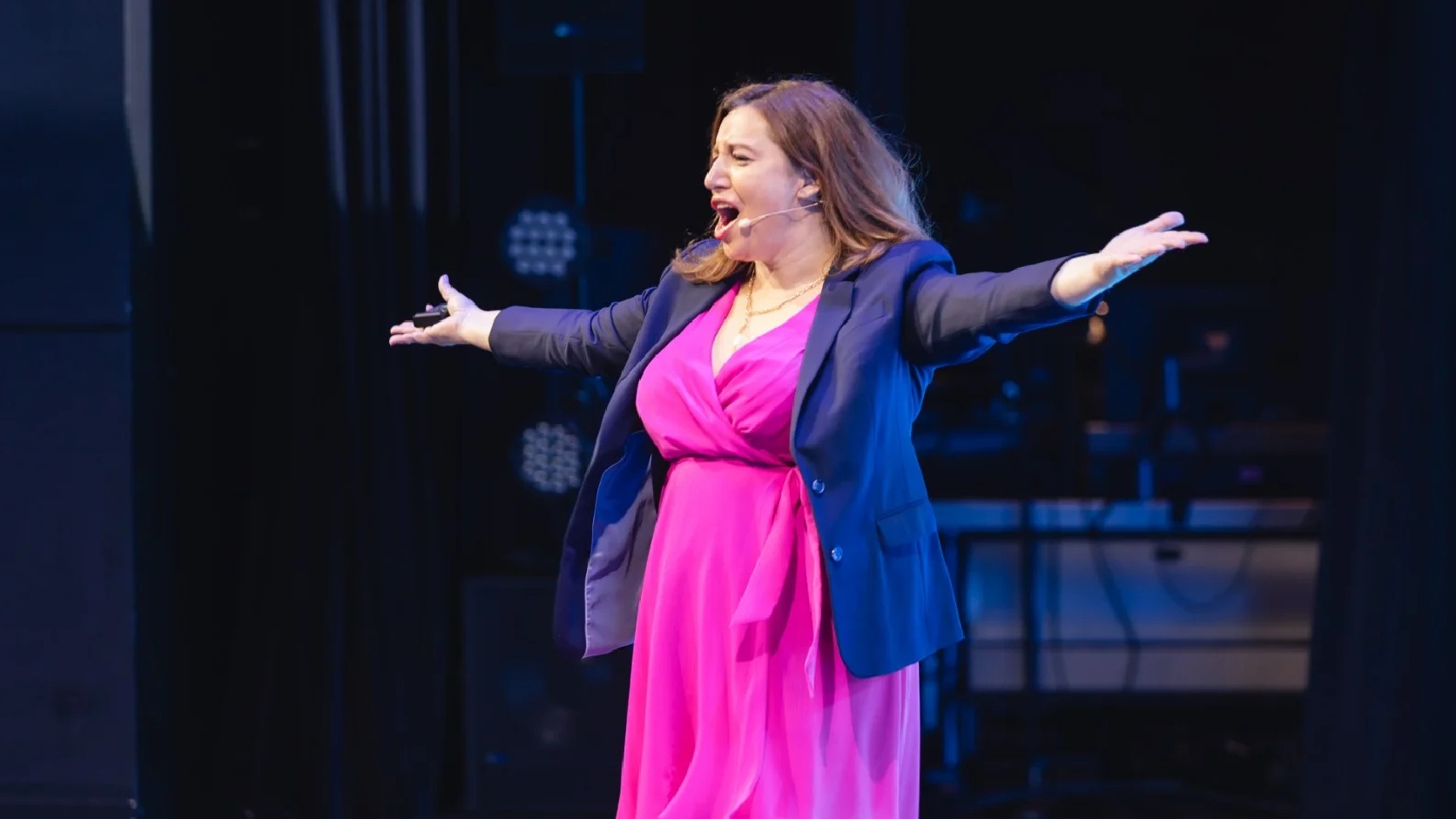
Dominika Staniewicz a Dynamic Corporate Keynote Speaker
Dominika Staniewicz brings a great deal of energy to a stage, but energy alone is not what makes her effective. Her strength is the ability to take a subject that could easily become technical or abstract and turn it into something an audience can understand, remember, and use.
That ability was developed over years rather than created for a speaking career. Dominika has taught in classrooms, trained corporate teams, appeared as a labor-market commentator, negotiated across competing interests, and explained complicated workforce issues to public audiences. Speaking is not a separate performance layered over her professional experience; it is one of the ways she delivers it.
Her current keynotes focus largely on stress, decision-making, sustainable performance, women in leadership, and the patterns that influence how people behave under pressure. Her style is animated and direct, with practical tools taking priority over theory for its own sake. Audience feedback regularly describes someone who can hold attention while making unfamiliar ideas feel manageable.
In 2025, Dominika brought that approach to TEDx Oconomowoc with “Why the Female Brain Is Built for Leadership,” a talk examining leadership and decision-making through the lens of her work in neuroscience and executive coaching. It was a natural extension of what she has done throughout her career: stand in front of a room, make a difficult subject easier to grasp, and leave people with something useful to consider after she has gone.
WHO: Dominika Staniewicz | WHOist: Charles J de Guara | 5th August 2026 | Source: Research & Experiential | Sponsor: GTK YC | B2B Sales Agency | Verified by: Charles J de Guara
The information presented reflects what was known and inferred at the time of this writing.
Dominika Knows How to Make Complex Ideas Usable
Based on what Dominika Staniewicz has shared through her teaching, coaching, and speaking, understanding an idea is not the same as being able to use it.
People are often given more information than they can realistically apply. A leader may understand that stress affects decision-making, an employee may recognize an unhelpful pattern, or a parent may hear a useful explanation of emotional regulation. None of that automatically tells them what to do when the situation occurs in real life.
Dominika’s approach is to create a bridge between recognition and action.
The first step is helping people recognize what is happening. Complex language is rarely useful when someone is already under pressure, so the explanation must connect to an experience they can identify in themselves: the moment they become defensive, lose focus, hesitate over a decision, or react before thinking.
The next step is to make the idea small enough to use. That does not mean oversimplifying it until it loses its meaning. It means removing what the audience does not immediately need and identifying one practical response they can remember when the situation returns.
A useful explanation should leave someone able to answer three questions:
What is happening?
They can recognize the pattern rather than simply feeling controlled by it.
Why does it matter?
They understand how the pattern may be affecting their decisions, communication, stress, or performance.
What can I do next?
They leave with a realistic action rather than another concept to admire and forget.
This is why Dominika places so much emphasis on practical tools. The purpose of explaining an idea is not merely to prove that the speaker understands it. The purpose is to help the audience do something differently because they now understand it too.
Whether she is discussing the brain, leadership, workplace behavior, or emotional regulation, the principle remains the same: knowledge becomes valuable when a person can recognize it in their own life and take a useful next step.
WHO: Dominika Staniewicz | WHOist: Charles J de Guara | 5th August 2026 | Source: Dominika Staniewicz | Sponsor: GTK YC | B2B Sales Agency | Verified by: Charles J de Guara
The information presented reflects what was known and inferred at the time of this writing.
Dominika spent much of her career running complicated operations.
Dominika’s current work is highly visible and personality-driven, which can obscure another side of her: she has spent much of her career running complicated operations.
She has built educational programs, managed recruitment teams, directed human-resources functions, introduced new systems, coordinated trainers across multiple locations, and worked inside organizations undergoing significant change. In one early project, she managed an HR rollout affecting approximately twelve thousand employees across sixteen call centers, coordinating more than sixty trainers while bringing the project in below its original financial plan.
Her later responsibilities included senior HR and operations roles in staffing, aviation services, education, recruitment, and technology. Some assignments involved growth; others involved restructuring, cost control, workforce reductions, or the replacement of outdated processes. These were not environments where enthusiasm could substitute for execution. They required planning, measurement, negotiation, documentation, and decisions that affected large numbers of people.
This operational history matters because it changes how her present work should be understood. When Dominika speaks to a leader about stress, communication, performance, or organizational behavior, she is not approaching those subjects solely from a coaching framework. She has been responsible for teams, budgets, systems, hiring targets, implementation schedules, and organizational outcomes of her own.
The speaker can command a room, and the coach can help someone examine a pattern. The operator underneath them understands that eventually an idea must survive contact with deadlines, competing interests, imperfect systems, and the people expected to carry it out.
WHO: Dominika Staniewicz | WHOist: Charles J de Guara | 5th August 2026 | Source: Research | Sponsor: GTK YC | B2B Sales Agency | Verified by: Charles J de Guara
The information presented reflects what was known and inferred at the time of this writing.
Dominika the Lecturer & Teacher
She began working in education in Poland, where she helped grow a language-learning operation from approximately twenty students into a multi-location organization serving more than fifteen hundred. The work required much more than classroom instruction. She recruited and developed teachers, built programs for children and adults, secured corporate clients, and helped create the structure necessary for an educational organization to grow without losing consistency.
Dominika later moved into higher education, serving as a program director and adjunct lecturer at Collegium Civitas. There, she helped design and launch postgraduate studies in human resources and management while teaching professionals preparing for more senior organizational responsibilities. Her research materials record exceptionally strong student evaluations—an early indication of the combination of command, accessibility, and personal energy that now characterizes her public speaking.
After relocating to the United States, she returned to formal education through academic leadership and adjunct teaching, including work at Lone Star College. Today, she continues that role in a different form through corporate workshops, keynote presentations, coaching programs, and the development of other practitioners.
Dominika has changed countries, industries, audiences, and subject matter, but she has rarely moved far from the work of helping someone understand something they could not fully use before. Coaching and speaking may now be the most visible expressions of her career, but underneath both is a teacher who has spent decades learning how people learn.
Teaching is one of the clearest continuous threads in Dominika’s career.
WHO: Dominika Staniewicz | WHOist: Charles J de Guara | 5th August 2026 | Source: Research | Sponsor: GTK YC | B2B Sales Agency | Verified by: Charles J de Guara
The information presented reflects what was known and inferred at the time of this writing.
Dominika the Brain Coach
Dominika founded Your Brain Coach D in 2023 after a career spanning education, human resources, workforce development, recruitment, mediation, and organizational leadership. Brain coaching gave those experiences a new center: helping people understand the patterns influencing how they respond to pressure, uncertainty, conflict, and change.
Her work draws on her training as an Elite Brain Coach and Neuroencoding Specialist and is organized around a method she describes as Recognize, Reboot, Rewire. In practical terms, she helps clients recognize an unhelpful response, interrupt the pattern that sustains it, and practice a more constructive way of thinking or acting.
Dominika applies that approach in both individual coaching and corporate training. With leaders and teams, her work focuses on stress, communication, emotional regulation, decision-making, workplace behavior, and sustainable performance. She has developed a particular focus on women in leadership and the pressures that can accompany stepping into more visible and demanding roles.
The important distinction is that Dominika does not approach brain coaching as an isolated interest. She brings to it decades spent observing people inside real organizations: employees adapting to new systems, managers communicating difficult decisions, negotiators working through disagreement, and leaders trying to perform while carrying considerable pressure. The terminology may have changed over the course of her career, but the underlying question has remained remarkably consistent: what helps people function better when the demands placed upon them increase?
WHO: Dominika Staniewicz | WHOist: Charles J de Guara | 5th August 2026 | Source: Research | Sponsor: GTK YC | B2B Sales Agency | Verified by: Charles J de Guara
The information presented reflects what was known and inferred at the time of this writing.
