
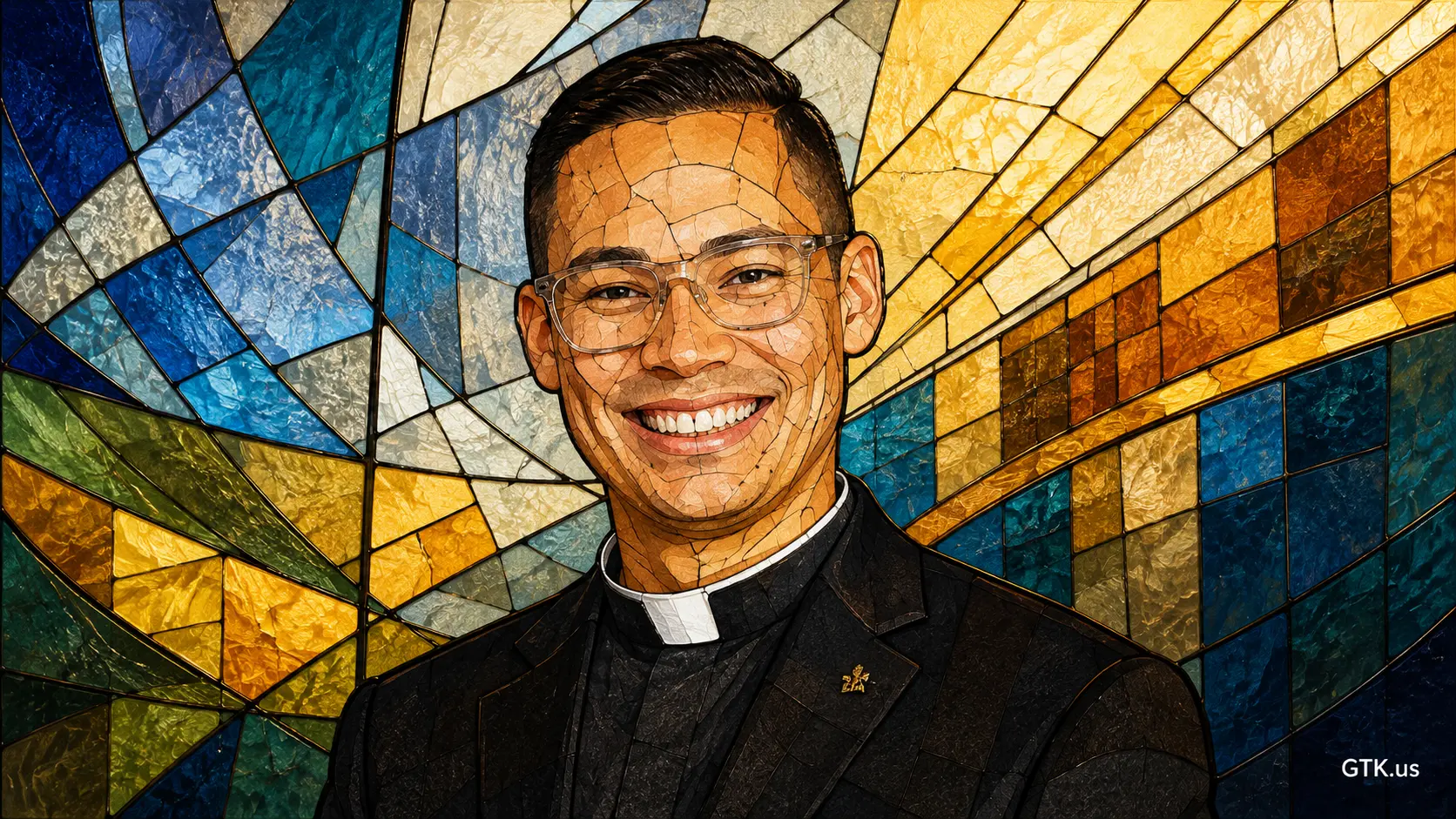
Who is Angel Garcia?
Parochial Administrator of Resurrection Catholic Church, Puerto Rican priest, served at Holy Cross Catholic Church, speaks Spanish, and known for his kind and joyful personality and his commitment to bringing people to Jesus through love.
Fr. Ángel García | Lego Builder
Fr. Ángel García likes Legos. It is one of the first things you notice when you step into his office or his room at the rectory. They are everywhere on shelves, on desks, some finished, some still waiting to be built. In a video posted by the Diocese of Orlando, he walked through his collection with the ease of someone showing you around a space that genuinely belongs to him. One set in particular stands out: a Lego scene depicting a priest celebrating Mass, with a small figure at the center that he pointed to and said, simply, "That's me."
What makes the collection personal is where most of it came from. Many of the sets are gifts from parishioners, and each one carries a specific meaning to him. "All of these are gifts from parishioners," he has said. "And it reminds me of their love for me and also my love for them. And so I pray for them." Whenever he looks at them, he remembers who gave them, and he prays for each one. What could easily be mistaken for a hobby is actually something closer to a quiet devotional practice. Each Lego set is a small reminder of a person, a relationship, and a prayer.
One gift in particular stands out among the rest, not a Lego, but a plush figure that looks like Grogu, the small character from the Star Wars series The Mandalorian, with the name of St. Paul's Parish stitched on the front of its clothes. It was given to him by parishioners before he left St. Paul's, and he described it as a beautiful memory of his time there. And among the completed Legos, there is a flower he built himself and placed in front of a statue of Our Lady of Divine Providence, the patroness of Puerto Rico. It is a small detail, but it says something about how he moves through the world: even in the ordinary, personal corners of his life, faith and the people he serves are never far from his mind.
WHO: Angel Garcia | WHOist: John Mar Turbanada | 19th July 2026 | Source: Research | Verified by: Charles J de Guara
The information presented reflects what was known and inferred at the time of this writing.
Fr. Ángel García | Puerto Rican-American
Fr. Ángel García is Puerto Rican American, and both sides of that identity run through nearly everything about him. He was born and raised in Trujillo Alto, Puerto Rico, where he grew up with his mother's side of the family in a household where faith was part of life but not yet the center of it. His family attended Mass on Sundays, and that was mostly it. As a teenager, he found Mass boring; the standing, sitting, and kneeling felt routine, and he began visiting other Christian churches with his friends, drawn by the energy and the music. It was during that season of searching that he realized something was always missing in those other spaces. He would later name it: the Eucharist. That recognition brought him back to the Catholic faith and became the beginning of everything that followed.
In 2013, he moved to Orlando to be closer to his father, and almost immediately found himself at a crossroads. He had been accepted to Valencia College, but a growing call to the priesthood would not leave him alone. Torn between the two paths, he prayed with a kind of directness that says something about who he is: "Lord, if you want me to go to seminary, you'll have to block my way to college." Weeks later, Valencia called to say there was a problem with his high school transcripts. When he contacted his school in Puerto Rico, the transcripts were missing entirely. "I thought, how can you lose someone's paperwork?" he recalled. "But then I remembered the prayer I had said. I said, okay Lord, I think you did your part. Now it's my turn." He applied to the seminary, and the transcripts came through with no problem. What began as a move to be closer to family became the start of a new life in the United States, one that would eventually lead him to ordination and parish ministry in Central Florida.
Even after years of building that life in Florida, Puerto Rico has never left him. A Puerto Rican flag hangs in his room at the rectory. In his office, he keeps a relic of Blessed Charlie, the first blessed from Puerto Rico, and a statue of Our Lady of Divine Providence, the patroness of Puerto Rico. He built a flower out of Legos and placed it in front of Our Lady. These are not decorations. They are the things that keep him close to where he comes from, even as he continues to put down roots where he is now.
And then there is the dancing. Growing up in Puerto Rico, music was a big part of daily life. Family gatherings were always loud, joyful events. That energy followed him into his life in America. At church events in Florida, when music starts playing, parishioners often see him doing dance moves and react with surprise. "Oh, Father, you can dance," they say. His response is always the same: "Of course. I'm Puerto Rican. It's natural." At the diocese's Focus 11 vocations event, he was photographed dancing along to the cajón as a seminarian played, during a game of musical chairs with hula hoops. It was exactly the kind of moment that reveals something about who he is, a Puerto Rican who built his life in America, and who carries both places with him wherever he goes.
WHO: Angel Garcia | WHOist: John Mar Turbanada | 19th July 2026 | Source: Research | Verified by: Charles J de Guara
The information presented reflects what was known and inferred at the time of this writing.
Fr. Ángel García | Knows How to Be Present
Fr. Ángel García has a way of showing up for people that begins before the formal parts of ministry even start. Before entering the church to celebrate Mass, he greets parishioners outside with warm hugs and friendly smiles, not just the people he knows well, but everyone, children, young adults, families, whoever happens to be arriving. It is the kind of thing that could go unnoticed if you were not paying attention, but it sets the tone for everything that follows. By the time Mass begins, many of the people sitting in the pews have already been personally welcomed.
That same presence carries into the less visible parts of his day. In the evenings, he attends meetings with the confirmandi and young adults at the parish. As he always does, he greets everyone warmly and approachably, making a point to connect before the meeting even begins. During the sessions, he speaks with them in a way that makes them feel comfortable and engaged, and they often end up laughing with him. It is not a technique. It is simply how he enters a room.
In his office at the parish, the walls and shelves are covered with images and objects given to him by parishioners, each one a gift with a specific meaning. He has spoken about how seeing those gifts reminds him of the people behind them, and how he prays for each of them. The office also holds his confessional stole, always ready and available for anyone who needs it. His approach to confession reflects the same directness: "I don't want you to sugarcoat it," he has told people. "I don't need no sugarcoating of your sins. When you go to confession, just be honest. The more honest you are, the more free you're going to feel."
That readiness also extends beyond the parish walls. When called to anoint someone at the hospital, he does not need to prepare. He keeps the oil of the sick and his stole in his pocket at all times, ready to go wherever he is needed. He has described those moments being there with a family at a time of healing or a time of frailty as one of the many things priests get to do. The way he says it suggests he does not see it as a burden. He sees it as part of what it means to be present.
He has also spoken plainly about the human side of the priesthood. "We're not perfect," he has said. "We're human. We make mistakes, but we count on and depend on your prayers. And just know that each one of you is in our prayers." For Fr. Ángel García, being present is not about being extraordinary. It is about being there at the door, in the meeting room, at the hospital bedside, and in the confessional consistently, warmly, and without pretense.
WHO: Angel Garcia | WHOist: John Mar Turbanada | 19th July 2026 | Source: Research | Verified by: Charles J de Guara
The information presented reflects what was known and inferred at the time of this writing.